
UTILITY DIRECTIONAL DRILLS

MIXING SYSTEMS

TRENCHERS, PLOWS, ROCKWHEELS

PILE DRIVERS

RECLAIMERS

PIERCING TOOLS
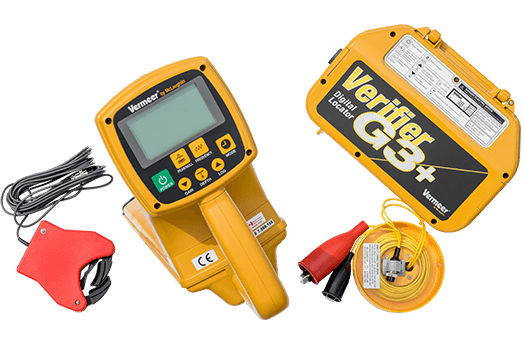

When installing underground utilities, choosing the right installation method can have a major impact on project time, cost and surface disruption.
Two common options are horizontal directional drilling (HDD) and traditional trenching. Both methods have their advantages. However, the right choice depends on the project, the jobsite and the ground conditions.
So, when should contractors choose HDD? And when is traditional trenching the better option?
Traditional trenching is an open-cut installation method. It involves excavating a trench along the planned utility route. The utility is then installed inside the trench before the area is backfilled and restored.
Trenching can be an effective solution when the work area is open and surface excavation is not a major concern.
It is often suitable for:
However, trenching can become more challenging in developed areas. Roads, sidewalks, driveways, buildings and existing utilities can increase the complexity of the project.
Restoration work can also add time and cost after installation.
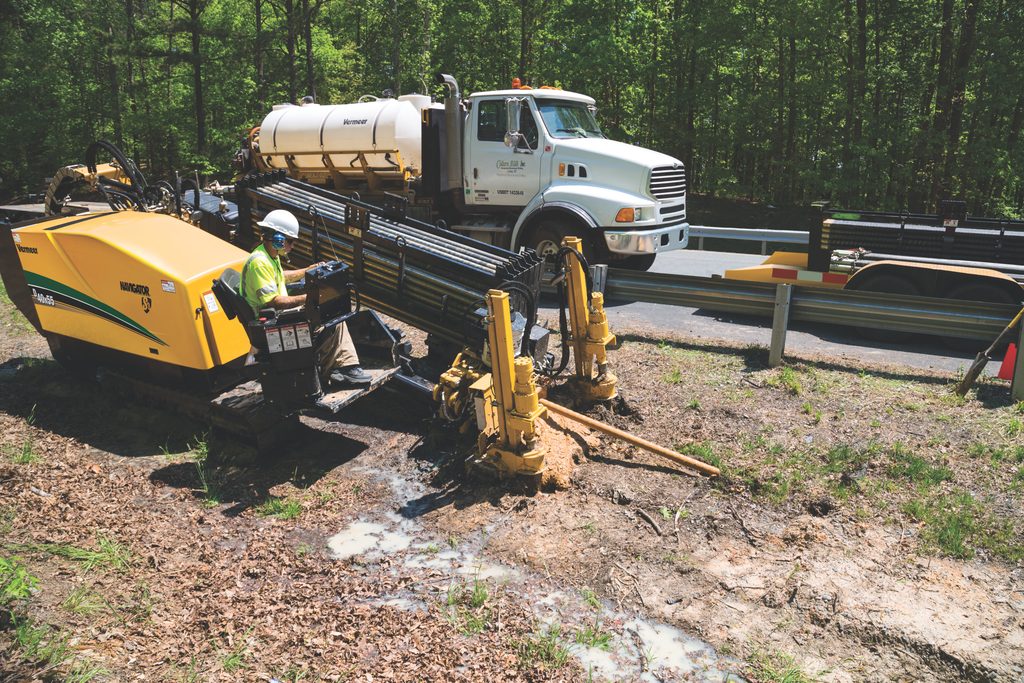
Horizontal directional drilling (HDD) is a trenchless installation method. Instead of opening a continuous trench, an HDD machine creates a controlled underground bore.
The process typically involves three main stages:
HDD allows contractors to install utilities beneath roads, railways, waterways and other surface obstacles with significantly less excavation.
This makes it particularly useful for urban and developed areas where traditional trenching could cause major disruption.
The best installation method depends on several project factors.
| Factor | Horizontal Directional Drilling | Traditional Trenching |
|---|---|---|
| Surface disruption | Low | Higher |
| Road crossings | Well suited | More disruptive |
| Railway crossings | Well suited | Highly disruptive |
| Waterway crossings | Suitable for many applications | Often difficult |
| Open areas | Can be suitable | Often practical |
| Restoration requirements | Generally reduced | Generally higher |
| Existing obstacles | Can drill beneath many obstacles | May require excavation around obstacles |
| Installation depth | Flexible, depending on project | Depends on excavation requirements |
Neither method is automatically better for every project. Contractors should evaluate the complete jobsite before selecting their equipment and installation method.
Choosing between horizontal directional drilling and traditional trenching requires more than comparing equipment.
Contractors should consider the complete project, including ground conditions, utility type, installation depth, bore length, access, existing infrastructure and restoration requirements.
When HDD is the right choice, having the appropriate equipment and support can make a significant difference to project efficiency.
Vermeer South East Europe provides a range of HDD machines for underground utility installation, supported by technical expertise, operator training, maintenance and regional after-sales support.
Explore the Vermeer HDD range and find the right solution for your next underground installation project.
Is HDD better than traditional trenching?
Not necessarily. The right method depends on the project. HDD is often advantageous where surface disruption, existing infrastructure or crossings make open excavation difficult. Trenching can be more practical in open areas with fewer obstacles.
What is the main advantage of horizontal directional drilling?
The main advantage is the ability to install utilities underground with significantly less surface excavation than traditional open-cut methods. This can be particularly useful for road, railway and waterway crossings.
When should contractors use trenching instead of HDD?
Trenching can be a practical option for open areas, greenfield developments and relatively shallow installations where surface excavation and restoration are manageable.
Can HDD and trenching be used on the same project?
Yes. Contractors can combine HDD with trenching to select the most appropriate installation method for different sections of the same project.
What factors determine the right HDD machine?
Machine selection depends on factors such as bore length, bore diameter, ground conditions, utility type, required thrust and pullback, and available setup space.
What utilities can be installed using HDD?
HDD can be used for a wide range of underground infrastructure, including fiber optic networks, telecommunications, electrical systems, water pipelines and gas pipelines.


